


This is an illustration of Desargues’s theorem. It says that two triangles are in perspective axially if and only if they are in perspective centrally.
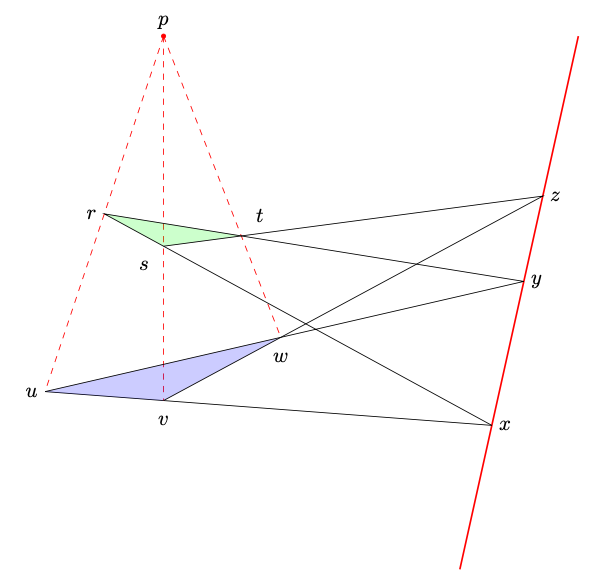
\documentclass[tikz,border=10pt]{standalone}
\usetikzlibrary{calc,intersections}
\begin{document}
\begin{tikzpicture}
  \coordinate [label=above:$p$] (p) at (2,9);
  \coordinate [label=left:$u$] (u) at (0,3);
  \coordinate [label=left:$r$] (r) at ($(p)!0.5!(u)$);
  % modification of numbers gives you modified illustrations
  \coordinate (q) at (2,2);
  \coordinate (l) at (7,0);
  \coordinate (m) at (9,9);
  \coordinate [label=right:$x$] (x) at ($(l)!0.27!(m)$);
  \coordinate [label=right:$y$] (y) at ($(l)!0.54!(m)$);
  \coordinate [label=right:$z$] (z) at ($(l)!0.7!(m)$);
  \draw [color=red,thick] (l) -- (m);
  \path [name path = pq] (p) -- (q);
  \draw [name path = ux] (u) -- (x);
  \path [name intersections={of = pq and ux,by = v}];
  \node [label=below:$v$] at (v) {};
  \draw [color=red,dashed] (p) -- (v);
  \path [name path = uy] (u) -- (y);
  \path [name path = vz] (v) -- (z);
  \path [name intersections={of = uy and vz,by = w}];
  \node [label=below:$w$] at (w) {};
  \draw [color=red,dashed,name path=pw] (p) -- (w);
  \path [name path = rx] (r) -- (x);
  \path [name path = ry] (r) -- (y);
  \path [name intersections={of = pq and rx,by = s}];
  \node [label=below left:$s$] at (s) {};
  \path [name intersections={of = pw and ry,by = t}];
  \node [label=above right:$t$] at (t) {};
  \fill [color=green,opacity=0.2] (r) -- (s) -- (t) -- (r);
  \fill [color=blue,opacity=0.2] (u) -- (v) -- (w) -- (u);
  \draw (x) -- (r) -- (y) (u) -- (y);
  \filldraw [fill=red,draw=red] (p) circle(1pt);
  \draw (s) -- (z) -- (v);
  \draw [color=red,dashed] (p) -- (u);
\end{tikzpicture}
\end{document}
By S. Bau; Sun Nov 2 12:53:39 AKST 2025